

In ultra-high-purity (UHP) gas systems, the valve plays a role comparable to the human heart's "valve": it must switch on and off precisely while minimizing particles, residual gas, and contamination from external sources as much as possible. There are many types of valves on the market - ball valves, needle valves, and bellows valves each have their loyalists - but in the most demanding clean applications, such as semiconductors and biopharmaceuticals, the diaphragm valve has almost become the "default answer." Why?
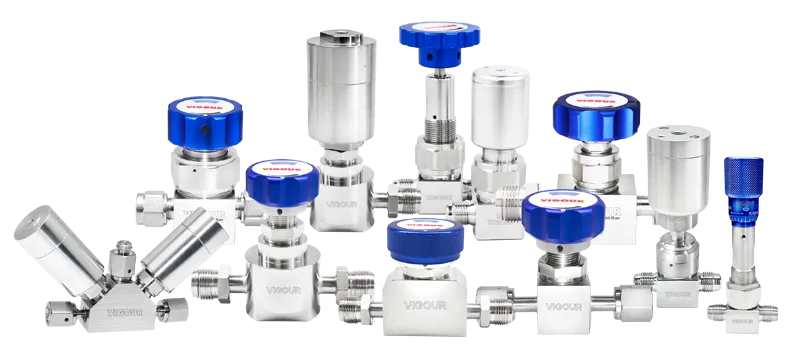
The core of the diaphragm valve: complete separation of "motion" from "flow"
Traditional valves sealed with stem packing rely on a dynamic seal between the valve stem and the body. Repeated opening and closing can wear the seal and cause leakage. Some conventional ball and needle valve designs also have relatively large dead volumes and regions that are difficult to purge thoroughly, leaving residual gas trapped in crevices that cannot be displaced. The diaphragm valve is fundamentally different: a flexible metal diaphragm (e.g., Elgiloy alloy) completely isolates the valve body from the actuator. The opening/closing action is achieved through deformation of the diaphragm. The wetted area contains no traditional stem packing structure, and the flow path is optimized to reduce dead volume - this is the root cause of its "high cleanliness."

Three major advantages, precisely matching UHP requirements
High gas tightness: The metal diaphragm isolates the process media from the drive mechanism and forms a packing-free external seal structure, eliminating dynamic-seal leakage paths. External leak rate can be controlled to the order of 10⁻⁹ mbar·l/s He.
Low dead volume: The flow path is straight and smooth, which improves purge efficiency and gas displacement, keeping cross-contamination risk extremely low.
Long service life: Diaphragm deformation stays within the elastic range; with proper control of diaphragm stress, a high cycle life can be achieved. Actual life depends on model and operating conditions, with low maintenance costs.
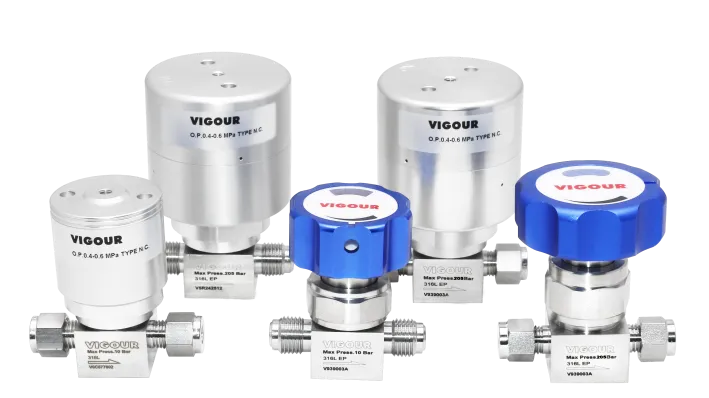
The VIGOUR diaphragm valve family
| Series | Model | Max. Pressure | Flow Coefficient (Cv) | Orifice / Tube Size | Port / Connection | Remarks |
|---|---|---|---|---|---|---|
|
General / High Purity (VHPS) |
VDV1 | 60 bar | 0.1 | Φ4 mm | 1/4" · 3/8" NPT(F) | Seat: PEEK; Diaphragm: Elgiloy® |
|
General / High Purity (VHPS) |
VDV2 | 20 bar (60 bar optional) | 0.1 | Φ3.2 mm | 1/4" NPT | - |
|
General / High Purity (VHPS) |
VDV8 | 40 bar | 0.6 | Φ8 mm | 3/8" · 1/2" NPT(F) | - |
|
General / High Purity (VHPS) |
VDV30 / VDV31 | 300 bar (60 bar optional) | 0.1 | Φ2.7 mm | - | - |
|
Ultra High Purity (VUPS) |
VDV33UB / VDV33UC | 3000 psig (200 bar) | 1/4": 0.27; 1/2": 0.5 | - | 1/4" – 1/2" VFS face seal | - |
|
Ultra High Purity (VUPS) |
VDV52UB / VDV52UC | 300 psig (20 bar) |
1/4": 0.3; 1/2": 0.65 |
- | - | - |
|
Ultra High Purity (VUPS) |
VDV37UB / VDV37UC |
Manual: 300 psig (20 bar); Pneumatic: 250 psig (17 bar) |
2.8 | - | - | High flow design |
|
Ultra High Purity (VUPS) |
VDV38UB / VDV38UC | 1300 / 3000 psig |
Manual: 1.0; Pneumatic: 1.0 (90 bar) / 0.7 (206 bar) |
Tube: 1/4" – 3/4" |
- | - |
| Item | Specification |
|---|---|
| Body | UC series: 316L double-remelted (VAR/SLV); UB series: 316L |
| Diaphragm | Co-Cr-Ni-Mo alloy (Elgiloy®) |
| Seal | PCTFE (Vespel® / PFA optional); Handwheel: aluminum alloy |
| Surface finish | Internal electropolishing (EP); UB series: 10 μin Ra; UC series: 7 μin Ra |
| Process standard | UB = VS001B; UC = VS001A (add "P" to the order number) |

In what scenarios are diaphragm valves a must?
| Application Scenario | Recommended Products | Key Considerations |
|---|---|---|
| Semiconductor Process Gas Circuit | VDV33UB/UC, VDV38UB/UC | Zero dead volume, zero leakage, ppb-level purity |
| Biopharmaceutical Clean Gas Circuit | VDV1/VDV2 Series | CIP/SIP capable, no contamination risk |
| Laboratory High-Purity Gas Supply | VDV52UB/UC | Fast response, easy disassembly & assembly |
| High-Flow Process Gas Mixing | VDV37UB/UC (Pneumatic) | Cv 2.8, compatible with automated control |
Of course, the diaphragm valve is not a silver bullet: compared with full-bore ball valves, conventional diaphragm valves typically have more limited flow capacity. For extremely high flow requirements, dedicated high-flow configurations must be selected based on Cv and pressure drop. They also cost more than ordinary needle valves. For these reasons, diaphragm valves are widely used in semiconductor UHP gas delivery, Gas Boxes, VMBs, and similar applications.
Contact the VIGOUR technical team for one-on-one selection support
Official website : https://www.vigourregulators.com/


