

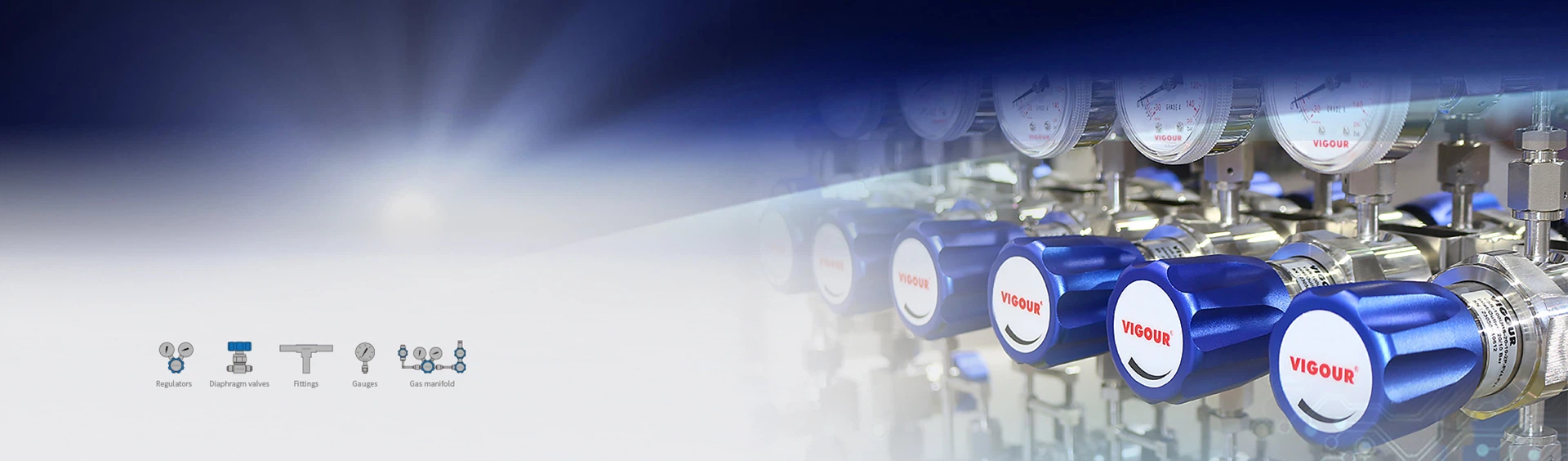
The HP Valves manufacture!
VIGOUR head office is located in Songjiang G60 Science and Technology Innovation Port, Shanghai, specializing in the research and manufacture of fluid control systems and pipe valve fittings.
-
![Low Pressure Diaphragm Valve]() Low Pressure Diaphragm Valve3 products corresponding to low pressure diaphragm valve: VDV1,VDV2,VDV8
Low Pressure Diaphragm Valve3 products corresponding to low pressure diaphragm valve: VDV1,VDV2,VDV8 -
![UHP Diaphragm Valve]() UHP Diaphragm ValveUHP diaphragm valve There are these 10 types in our company:VDV31UA, VDV32UB, VDV33UB, VDV52UB, VDV22UB, VDV36,VDV37,VDV38,VDV39,VDV40,
UHP Diaphragm ValveUHP diaphragm valve There are these 10 types in our company:VDV31UA, VDV32UB, VDV33UB, VDV52UB, VDV22UB, VDV36,VDV37,VDV38,VDV39,VDV40, -
![Pressure Gas Needle Valve]() Pressure Gas Needle Valve2 pressure gas needle valve related products:VNV, VSNV
Pressure Gas Needle Valve2 pressure gas needle valve related products:VNV, VSNV -
![Stainless Steel Gas Ball Valve]() Stainless Steel Gas Ball ValveStainless steel gas ball valve has these 4 models in our company:VBV1, VBV2, VBV3, VBV4
Stainless Steel Gas Ball ValveStainless steel gas ball valve has these 4 models in our company:VBV1, VBV2, VBV3, VBV4 -
![High Pressure Gas Relief Valve]() High Pressure Gas Relief ValveHigh Pressure Gas Relief Valve corresponding products VSV1,VSV2
High Pressure Gas Relief ValveHigh Pressure Gas Relief Valve corresponding products VSV1,VSV2 -
![High Pressure Gas Check Valve]() High Pressure Gas Check ValveModel VCV VCV1 VCV2 VCVH VCV Technical parameters VCV1 Technical parameters VCV2 Technical parameters VCVH Technical parameters High Pressure Gas Check Valve Simplified Explanation What is it? In
High Pressure Gas Check ValveModel VCV VCV1 VCV2 VCVH VCV Technical parameters VCV1 Technical parameters VCV2 Technical parameters VCVH Technical parameters High Pressure Gas Check Valve Simplified Explanation What is it? In -
![High Pressure Diaphragm Valve]() High Pressure Diaphragm ValveThe high pressure diaphragm valve corresponds to our 2 models:VDV30,VDV31
High Pressure Diaphragm ValveThe high pressure diaphragm valve corresponds to our 2 models:VDV30,VDV31


Why choose us
Rich in experience
The team has rich experience, complete technical products, and strong cutting-edge research and development capabilities, and is committed to providing intelligent fluid control solutions to ensure that customers enjoy high-quality products and ultimate experience.
Advanced equipment
Through integrated line design, we achieve a smooth transition from research and development to production, ensuring product excellence and stability. Vig is committed to providing high-quality, efficient solutions to help customers get a head start in the market.
Glories of Company
Haogu has obtained over 30 EU CE (PED ISO2503), ISO9001, Rohs invention patent certificates, and utility model certificates.
Technical Specifications
| Body Material | Stainless Steel, brass, or PVC |
| Pressure Rating | 150 PSI to 6000 PSI |
| Temperature Range | -20 °C to 200 °C (-4 °F to 392 °F) |
| End Connections | Threaded, flanged, and welded ends |
| Operation | The valves can be operated manually with a handle or automatically with an actuator |
| Flow Characteristics | Quick and full-bore flow with minimal pressure drop |
| Leakage Rate | Low leakage rate, typically classified as bubble-tight |
| Standards | API, ANSI, and ISO |

Features of HP Valves
High pressure valves and fittings are available in stainless steel, brass, PVC, cast iron, and more.
They come in different sizes and configurations to adapt to various flow rates and applications.
They come with specific pressure ratings that indicate the maximum pressure they can safely handle.
High pressure fittings have different end connections, including threaded, welded, flanged, or push-fit. The choice of end connection should match the required piping system and installation method.
High pressure valves provide different methods of flow control, such as on/off (e.g., ball valves), throttling (e.g., gate valves), or directional control (e.g., check valves).
Corrosion-resistant materials or protection coating can extend their lifespan in corrosive environments.
Applications of High-Pressure Valves
Oil and Gas Industry
They are widely used in the oil and gas industry for drilling, production, and transportation. They handle extreme pressures and harsh conditions, guaranteeing safe and efficient operation.
Chemical Processing
High-pressure valves control the flow of reactive and corrosive chemicals in chemical processing plants. Their robust construction ensures reliability and safety in demanding environments.
Power Generation
High-pressure valves are critical in power generation systems, including steam turbines and boilers. They regulate steam flow and pressure for efficient energy production and system stability.
Water Treatment
Water treatment facilities use these to manage the flow of water. It is being used in filtration systems, pumps, and other components. These valves are key to efficient and safe water treatment.
Safety Instructions
| Manual Review | Read and understand the supplier's manual thoroughly. |
| Regular Inspections | Check for damage, leaks, and corrosion routinely. |
| Proper Installation | Install the valve correctly using recommended methods. |
| Stay within Limits | Operate the valve within specified pressure and temperature ranges. |
| Handle with Care | Avoid over-tightening the handle to prevent damage. |
| Maintenance Schedule | Follow a regular maintenance plan as per manufacturer's guidelines. |
| Emergency Awareness | Know how to shut off the valve during emergencies quickly. |
| Wear PPE | Use appropriate protective gear when handling hazardous materials. |
| Training | Ensure operators are trained in safe usage and hazards. |
| Seek Guidance | Consult experts regarding any uncertainties regarding safety procedures. |
Structure and Material of HP Valves
Materials: The choice of materials for high-pressure valves is pivotal. Typically, industrial-grade materials such as stainless steel (like types 304, 316), carbon steel, or other special alloys are utilized. These materials are selected based on their exceptional tensile strength, yield strength, and corrosion resistance, which are essential properties to withstand high-pressure environments. For certain applications demanding more resistance to extreme temperatures or corrosive substances, exotic materials like Hastelloy, Monel, or Inconel might be used.
Body: The body of the valve, often referred to as the valve housing or shell, is the primary pressure-containing component. It must be engineered to hold up under the most extreme conditions that the valve may encounter.
Internals: Within the valve body, various internal components exist such as the valve seat, disc, stem, packing, etc. The design of these parts depends upon the specific type of valve and its function. For example, ball valves will contain a rotating ball with a port, whereas gate valves will have a “gate” or “wedge” that moves linearly to control fluid flow.
Seals and Gaskets: Sealing elements play a crucial role in the function of a high-pressure valve. They prevent any unwanted escape of the medium (gas, liquid) from the system. Materials for seals and gaskets are chosen for their ability to maintain a tight seal despite the high pressure, and often they need to resist chemical attack from the medium. Typical materials for these include PTFE (Teflon), graphite, or elastomeric compounds.
End Connections: The type of end connections is also crucial in the design of high-pressure valves, as they must securely attach the valve to the piping system. Threaded, flanged, or welded connections are commonly used, depending on the requirements of the system.
Pressure rating of HP Valves
|
Temperature ℃ |
Class 150 |
Class 300 |
Class 400 |
Class 600 |
Class 900 |
Class 1500 |
Class 2500 |
|
-29 to 38 |
19.6 |
51.1 |
102.1 |
153.2 |
255.3 |
425.5 |
765.9 |
|
50 |
19.2 |
50.1 |
100.2 |
150.4 |
250.6 |
417.7 |
751.9 |
|
100 |
17.7 |
46.6 |
93.2 |
139.8 |
233.0 |
388.3 |
699.0 |
|
150 |
15.8 |
45.1 |
90.2 |
135.2 |
225.4 |
375.6 |
676.1 |
|
200 |
13.8 |
43.8 |
87.6 |
131.4 |
219.0 |
365.0 |
657.0 |
|
250 |
12.1 |
41.9 |
83.9 |
125.8 |
209.7 |
349.5 |
629.1 |
|
300 |
10.2 |
39.8 |
79.6 |
119.5 |
199.1 |
331.8 |
597.3 |
|
325 |
9.3 |
38.7 |
77.4 |
116.1 |
193.6 |
322.6 |
580.7 |
|
350 |
8.4 |
37.6 |
75.1 |
112.7 |
187.8 |
313.0 |
563.5 |
|
375 |
7.4 |
36.4 |
72.7 |
109.1 |
181.8 |
303.1 |
545.5 |
|
400 |
6.5 |
34.7 |
69.4 |
104.2 |
173.6 |
289.3 |
520.8 |
|
425 |
5.5 |
28.8 |
57.5 |
86.3 |
143.8 |
239.7 |
431.5 |
|
450 |
4.6 |
23.0 |
46.0 |
69.0 |
115.0 |
191.7 |
345.1 |
|
475 |
3.7 |
17.4 |
34.9 |
52.3 |
87.2 |
145.3 |
261.5 |
|
500 |
2.8 |
11.8 |
23.5 |
35.3 |
58.8 |
97.9 |
176.3 |
|
538 |
1.4 |
5.9 |
11.8 |
17.7 |
29.5 |
49.2 |
88.6 |
Our factory
This modern industrial park is designed to integrate research and development, manufacturing, warehousing, and comprehensive lifestyle facilities. To ensure uninterrupted operations during the construction phase, the company has taken the strategic step of relocating to the LianDong U Valley Nantong Project.
FAQ
We're professional HP valves manufacturers and suppliers in China, specialized in providing high quality customized service. We warmly welcome you to wholesale HP valves for sale here from our factory. For quotation, contact us now.
energy efficient valves, valve lead time, wholesale valvesPopular Products


