

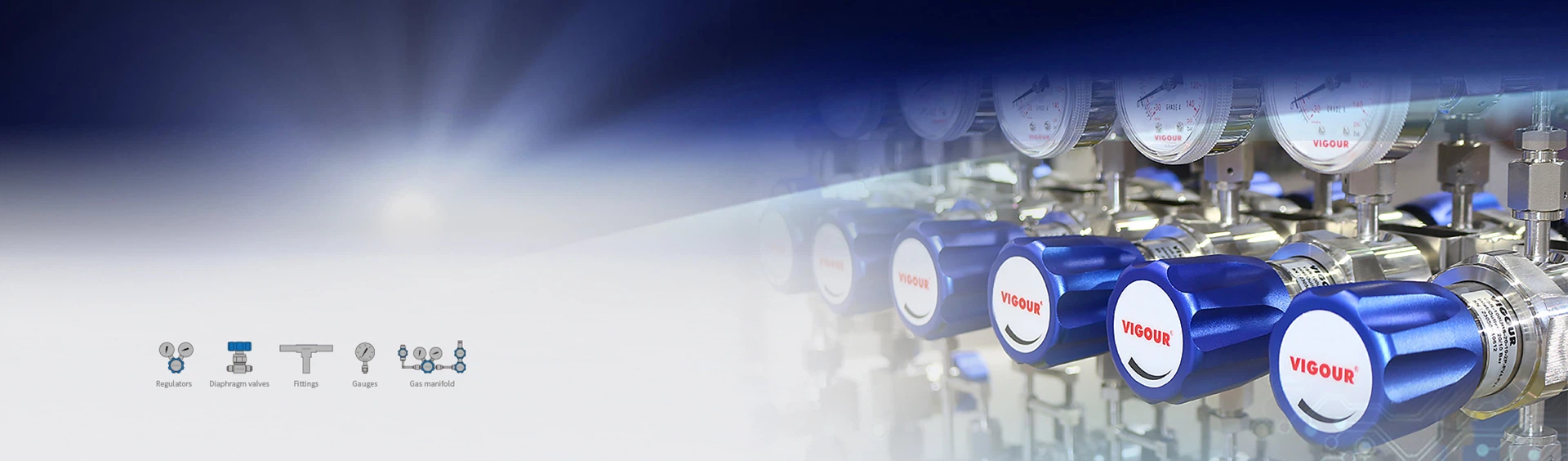
The Hp Gas Regulators manufacture!
VIGOUR head office is located in Songjiang G60 Science and Technology Innovation Port, Shanghai, specializing in the research and manufacture of fluid control systems and pipe valve fittings.
-
![High in High Out Gas Pressure Regulator]() High in High Out Gas Pressure RegulatorThe high in high out gas pressure regulator corresponds to our 4 products:VSR-11EH. VSR-6ES, VSR-7S, VSR-8S
High in High Out Gas Pressure RegulatorThe high in high out gas pressure regulator corresponds to our 4 products:VSR-11EH. VSR-6ES, VSR-7S, VSR-8S -
![700bar Pressure Gas Regulator]() 700bar Pressure Gas RegulatorThe 700bar pressure gas regulator corresponds to 1 model of our company: VSR-8S
700bar Pressure Gas RegulatorThe 700bar pressure gas regulator corresponds to 1 model of our company: VSR-8S -
![Single Stage Gas Pressure Regulator]() Single Stage Gas Pressure RegulatorSingle stage gas pressure regulator corresponds to our 4 models:VSR-1ES, VSR-2ES, VSR-3S,
Single Stage Gas Pressure RegulatorSingle stage gas pressure regulator corresponds to our 4 models:VSR-1ES, VSR-2ES, VSR-3S, -
![Petroleum Industrial Use Gas Pressure Regulator]() Petroleum Industrial Use Gas Pressure RegulatorThe petroleum industrial use gas pressure regulator corresponds to the company's 4 products:VSR-2EPH,VSR-3PH,VSR-4PH,VSR-10PH
Petroleum Industrial Use Gas Pressure RegulatorThe petroleum industrial use gas pressure regulator corresponds to the company's 4 products:VSR-2EPH,VSR-3PH,VSR-4PH,VSR-10PH -
![Food Industrial Use Gas Pressure Regulator]() Food Industrial Use Gas Pressure RegulatorThe food industrial use gas pressure regulator corresponds to 2 products of our company:VSR-3F,VSR-4F
Food Industrial Use Gas Pressure RegulatorThe food industrial use gas pressure regulator corresponds to 2 products of our company:VSR-3F,VSR-4F -
![Brass Gas Pressure Regulator]() Brass Gas Pressure RegulatorBrass gas pressure regulator corresponds to 9 products:VGR-11, VGR-14, VGR-25,VGR-28,VGR-10, VLR-15, VLR-18,VFR-33, VFR-31.
Brass Gas Pressure RegulatorBrass gas pressure regulator corresponds to 9 products:VGR-11, VGR-14, VGR-25,VGR-28,VGR-10, VLR-15, VLR-18,VFR-33, VFR-31. -
![Medical Gas Pressure Regulator]() Medical Gas Pressure RegulatorThe medical gas pressure regulator is our VMR-1A Medical Gas Pressure Regulator VMR-1 is a specialized device used to control the pressure of medical gases in healthcare facilities, such as
Medical Gas Pressure RegulatorThe medical gas pressure regulator is our VMR-1A Medical Gas Pressure Regulator VMR-1 is a specialized device used to control the pressure of medical gases in healthcare facilities, such as -
![Pressure Regulator Extension]() Pressure Regulator ExtensionThe pressure regulator extension corresponds to our product model: VSP-1X
Pressure Regulator ExtensionThe pressure regulator extension corresponds to our product model: VSP-1X -
![Dual Stage Gas Pressure Regulator]() Dual Stage Gas Pressure Regulatordual stage gas pressure regulator makes our product model: VSR-11ES
Dual Stage Gas Pressure Regulatordual stage gas pressure regulator makes our product model: VSR-11ES -
![Pressure Regulator Gas Stick]() Pressure Regulator Gas Stickpressure regulator gas stick corresponds to our 9 product types:VSR-1ET, VSR-1ETG, VSR-1ETGBv , VSR-2T, VSR-2TG, VSR-3T,VSR-3TG, VSR-4T, VSR-5T.
Pressure Regulator Gas Stickpressure regulator gas stick corresponds to our 9 product types:VSR-1ET, VSR-1ETG, VSR-1ETGBv , VSR-2T, VSR-2TG, VSR-3T,VSR-3TG, VSR-4T, VSR-5T. -
![Low Pressure High Flow Regulator]() Low Pressure High Flow RegulatorLow pressure high flow regulator corresponds to our 4 types of products:VSR-12L,VSR-4L, VSR-10L, VSR-10PH
Low Pressure High Flow RegulatorLow pressure high flow regulator corresponds to our 4 types of products:VSR-12L,VSR-4L, VSR-10L, VSR-10PH -
![High Pressure High Flow Regulator]() High Pressure High Flow RegulatorHigh pressure high flow regulator corresponds to our 2 models:VSR-36, VSR-7S
High Pressure High Flow RegulatorHigh pressure high flow regulator corresponds to our 2 models:VSR-36, VSR-7S


Why choose us
Rich in experience
The team has rich experience, complete technical products, and strong cutting-edge research and development capabilities, and is committed to providing intelligent fluid control solutions to ensure that customers enjoy high-quality products and ultimate experience.
Advanced equipment
Through integrated line design, we achieve a smooth transition from research and development to production, ensuring product excellence and stability. Vig is committed to providing high-quality, efficient solutions to help customers get a head start in the market.
Glories of Company
Haogu has obtained over 30 EU CE (PED ISO2503), ISO9001, Rohs invention patent certificates, and utility model certificates.
|
Gas type |
Nitrogen |
|
Back pressure |
0-10 bar |
|
Readability |
0,5 bar |
|
Bottle connection |
W 24.32 x 1/14″ right |
|
Tube connection |
G 1/4″ right |
|
Upstream pressure, max. |
200 bar |
|
Operating temperature |
-20 to +60 °C |
|
L x W x H |
180 x 65 x 170 mm |
|
Weight |
1,7 kg |
Benefits of Pressure Gas Regulator

Enhanced Safety
By controlling gas pressure, these regulators prevent potential leaks and explosions.
Improved Efficiency
Proper pressure regulation ensures that gas-fired appliances operate optimally, saving energy and reducing operational costs.
Durability and Reliability
High-quality materials and construction ensure regulators can withstand environmental and operational stresses, resulting in fewer failures and lower maintenance costs.
Different Types of Gas Regulators
Low pressure: This type of regulator is commonly used for gases like natural gas or propane, which are supplied at high pressure, and it reduces their pressure to a safe level for consumption by devices. The pressure adjustment in these types of regulators is done using a diaphragm and spring mechanism. The output pressure of such regulators typically ranges from 0 to 0.5 bar.
Medium pressure: This type of balancer is used to adjust and reduce the inlet gas pressure within a medium pressure range. It is designed for systems that require a pressure higher than low pressure but lower than high pressure, and is commonly used in industrial, commercial, and some specific residential applications. The pressure adjustment in these types of regulators is done by a diaphragm and spring mechanism. The output pressure of these regulators typically ranges from 0.1 to 4 bar.
High pressure: This type is used to adjust and reduce the inlet gas pressure in very high ranges. It is designed to reduce high-pressure gases to a controllable output pressure suitable for use in specific industrial, medical, and laboratory systems. Pressure regulation in these types of balancers is done by a diaphragm and spring mechanism, which operates through a control valve connected to the diaphragm and spring. The output pressure of these regulators typically ranges from 0.1 to 34 bar.
Pulse-line: A pulse-line gas regulator is designed to control pressure using a specific method. This type is commonly used in industrial systems and applications that require precise pressure control, particularly where the gas flow fluctuates in a pulsed manner. In this type, pulse signals are sent to the regulator to adjust the pressure. Due to the use of pulse lines, these devices can regulate pressure and quickly respond to rapid changes in input pressure and load demand. The output pressure of these regulators typically ranges from 0.1 to 34 bar.
Pilot-operated: It is designed for precise pressure control using a pilot system. This pilot system includes a separate control valve that sends the necessary signals to the main regulator to adjust the pressure. These types of regulators are typically designed for applications requiring high accuracy and complex conditions. The pressure adjustment in these regulators works as follows: The pilot valve independently controls the pressure on a smaller scale and sends signals to the main regulator. The main regulator then responds to the signals received from the pilot and adjusts the output pressure according to the pilot's settings. The output pressure range of these regulators typically falls between 0.1 and 34 bar.
Installation of Pressure Gas Regulator
Begin by connecting the pressure source to the inlet port and the regulated pressure line to the outlet port. If the ports are not marked, check with the manufacturer to avoid incorrect connections. In some designs, damage can occur to the internal components if the supply pressure is mistakenly supplied to the outlet port.
Before turning on the supply pressure to the regulator, back off the adjustment control knob to restrict flow through the regulator. Gradually turn on the supply pressure so as not to "shock" the regulator with a sudden rush of pressurized fluid. NOTE: Avoid turning the adjustment screw all the way into the regulator because, in some regulator designs, the full supply pressure will be delivered to the outlet port.
Set the pressure regulator to the desired outlet pressure.If the regulator is non-relieving, it will be easier to adjust the outlet pressure if fluid is flowing rather than "dead ended" (no flow). If the measured outlet pressure exceeds the desired outlet pressure, vent the fluid from the downstream side of the regulator and lower the outlet pressure by turning the adjustment knob. Never vent fluid by loosening fittings, as injury may result.
To obtain the desired outlet pressure, make the final adjustments by slowly increasing the pressure from below the desired set point. Setting the pressure from below the desired setting is preferred to setting it from above the desired setting. If you overshoot the set point while setting the pressure regulator, back off the set pressure to a point below the set point. again, gradually increase the pressure to the desired set point.
Cycle the supply pressure on and off several times while monitoring the outlet pressure to confirm the regulator is consistently returning to the set point. Additionally, the outlet pressure should also be cycled on and off to ensure the pressure regulator returns to the desired set point.Repeat the pressure setting sequence if the outlet pressure does not return to the desired setting.
Payment Terms
Cash on Delivery (COD)
Days after Acceptance (DA)
Cash Against Delivery (CAD)
Cash in Advance (CID)
Cheque, Cash Advance (CA)
Our factory
This modern industrial park is designed to integrate research and development, manufacturing, warehousing, and comprehensive lifestyle facilities. To ensure uninterrupted operations during the construction phase, the company has taken the strategic step of relocating to the LianDong U Valley Nantong Project.
FAQ
We're professional HP gas regulators manufacturers and suppliers in China, specialized in providing high quality customized service. We warmly welcome you to wholesale HP gas regulators for sale here from our factory. For quotation, contact us now.
hp gas regulators, Brass Gas Pressure Regulator, Medical Gas Pressure RegulatorPopular Products


