


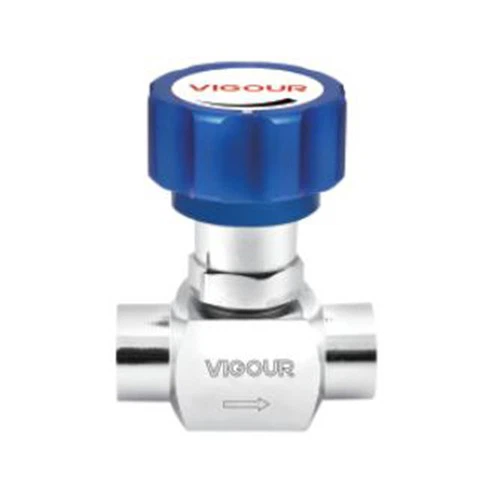

Model
|
VDV1 |
VDV2 |
VDV8 |


Low Pressure Diaphragm Valve VDV1
Introduction
• High pressure, high flow regulator • Brass chrome plated body and bonnet for inert, reactive, flammable and oxidizing oxidizing gas and mixtures up to grade 6.0 • Stainless steel 316L body for pharmaceutical, food and beverage application • Simple outlet pressure limitation by handwheel • Self-venting standard • Stable outlet pressure • Tested for use with oxygen |
|
|
Application
• Component Testing • Calibration Systems • Laboratory Pressure Control • High Pressure Sampling Systems • Service & Test Equipment |
Technical parameters
| Type | Diaphragm valve |
| Inlet pressure | max. 60 bar |
| Materials | |
| Body | see ordering info |
| Seat | PEEK |
| Diaphragm | Elgiloy® |
| Filter | SS316L |
| Inlet / outlet connection | 1/4"NPT(F) |
| Temperature range | -30℃ to +74℃ |
| Leak rate | 10^-8 mbar I/s He |
| Weight | 0.5 kg |
Low Pressure Diaphragm Valve VDV2
Introduction
• Diaphragm valve • Brass chrome plated body for inert, reactive, flammable and oxidizing gas and mixtures up to grade 6.0 • Stainless steel 316L body for corrosive gases • Suitable for inlet pressure up to 60 bar, hand wheel design • Wide range of inlets / outlets • Metal-to-metal sealing to atmosphere • Tested for use with oxygen
|
|
Application
• Component Testing • Calibration Systems • Laboratory Pressure Control • High Pressure Sampling Systems • Service & Test Equipment
|
Technical parameters
| Type | Diaphragm valve |
|
| Inlet pressure | max. 60 bar | |
| Materials | ||
| Body | see ordering info | |
| seat | PEEK | |
| Diaphragm | Hastelloy® C276 | |
| Inlet / Outlet connection | 1/4"NPT | |
| Temperature range | -30℃ to +74℃ | |
| Leak rate | 1x10^-8 mbar I/s He | |
| Weight | 0.3kg | |

Low Pressure Diaphragm Valve VDV8
Introduction:
• Diaphragm valve
• Brass chrome plated body for inert, reactive, flammable
and oxidizing gas and mixtures up to grade 6.0
• Stainless steel 316L body for corrosive gases
• Suitable for inlet pressure up to 40 bar
• Wide range of inlets / outlets
• Metal-to-metal sealing to atmosphere
• Tested for use with oxygen
Application
• Component Testing
• Calibration Systems
• Laboratory Pressure Control
• High Pressure Sampling Systems
• Service & Test Equipment
Technical parameters
| Type | Diaphragm valve |
|
| Inlet pressure | max. 40 bar | |
| Materials | ||
| Body | see ordering info | |
| seat |
PEEK |
|
| Diaphragm | Hastelloy® C276 | |
| Temperature range | -30℃ to +74℃ | |
| Leak rate | 1x10^-8 mbar I/s He | |
| Weight | 0.8kg | |

Simplified Explanation
In simple terms: A "gentle gas switch" designed for low-pressure gas systems, where the diaphragm plays the role of a soft barrier to control gas flow. It's like a faucet for gas-slow and steady, but reliable, keeping things sealed tight without the need to fight high pressures.
- Low Pressure Friendly: Typically designed for operating pressures up to 60 bar (about the pressure you'd find in a standard gas tank, much lower than high-pressure systems).
- Seamless Seal: The diaphragm separates the gas flow without any moving parts coming into contact with the gas, making it perfect for high-purity and less aggressive gases (like nitrogen, oxygen, or CO2).
- Flexible Operation: Available with either a handwheel (for fine flow control) or a lever (for quick shut-off), so you can control the gas flow exactly how you need it.
Analogy: It's like adjusting the water flow from a garden tap-gentle, controllable, and always reliable.
- Low-pressure gas systems: Managing gases like nitrogen or CO2 in cylinders or storage tanks with pressures around 60 bar.
- Chemical processing: Regulating the flow of non-corrosive gases in pipelines where pressure is relatively low.
- Laboratory setups: Precise control of gases (like oxygen or air) for experiments, ensuring purity without overcomplicating things.
- Energy sector: Fuel lines for equipment or stations operating at low pressure (e.g., certain natural gas or biogas applications).
Two operation modes:
Handwheel version:
Suitable for: Applications where small, precise adjustments to flow or pressure are needed (like labs or medical systems).
Operation: Rotate the handwheel slowly, and the diaphragm moves gently to control gas flow, just like fine-tuning the faucet.
Lever version:
Suitable for: Applications requiring quick gas shut-off or frequently operated systems (like industrial processes).
Operation: Pull the lever 90°, and the diaphragm immediately opens or closes, giving you quick on/off control.
- Direction matters: The valve body will have an arrow showing the gas flow direction (→), so be sure to align it correctly when installing.
- Interface matching: Ensure the thread type (e.g., G-thread, NPT) and size match your system, and use sealing tape if necessary.
- Check the diaphragm regularly: Even at low pressure, diaphragms can wear over time, so follow the manufacturer's guidelines for maintenance and replacement.
Issue 1: Valve doesn't seal properly (leaks)
Cause: Diaphragm wear or cracking, dirt in the valve seat, or damaged seals.
Solution: Replace the diaphragm, clean the valve seat, and inspect the seals.
Issue 2: Handwheel/lever hard to operate
Cause: Diaphragm sticking, lack of lubrication on moving parts, or build-up of pressure inside.
Solution: Release pressure before operating, lubricate the valve stem, and replace the diaphragm if needed.
Issue 3: Diaphragm failure
Cause: Overpressurization (more than 60 bar) or exposure to incompatible chemicals.
Solution: Ensure the system pressure doesn't exceed the rated 60 bar, and choose diaphragms made from resistant materials (e.g., PTFE or elastomers suited for specific gases).
Issue 4: Lever version not fully opening/closing
Cause: Incorrect installation angle or loose limit screws.
Solution: Adjust the valve orientation during installation and tighten any loose screws.
A low-pressure diaphragm valve is a "gentle gas switch" for controlling flows up to 60 bar. The handwheel allows precise adjustments, while the lever offers quick on/off action. Make sure to stay within the 60 bar limit for safe, reliable operation.
For selection, simply ask the manufacturer: "I need to control CO2 at 60 bar. Should I choose a handwheel or lever? And what diaphragm material is best for my application?"
Hot Tags: low pressure diaphragm valve, China low pressure diaphragm valve manufacturers, suppliers, valve dimensions, butterfly valves, valve bodies, food and beverage industry valve applications, industrial valves, valve urethane coating


