


How to choose the right pressure regulator?
Pressure regulators are essential devices that reduce high pressure to a lower, more stable level. Choosing the right regulator is crucial for safety, efficiency, and equipment protection. Although there are many types available-which can sometimes be confusing-understanding a few key factors will help you select the best regulator for your needs.
1️⃣Clarify the gas medium
First, you need to determine the type of gas medium you require. A pressure regulator is primarily a high-pressure gas reducing device, and different gases require different types of regulators.
For example, inert gases, flammable gases, corrosive gases, and toxic gases all require the selection of suitable pressure regulators; otherwise, they may cause serious problems.
Here are some common gases:


2️⃣Confirm the inlet and outlet pressure
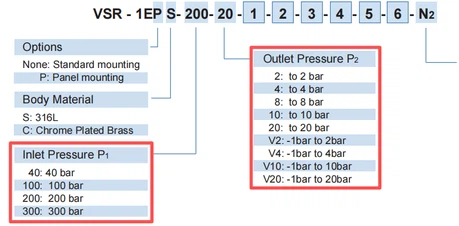
P1 (Inlet pressure):
Pressure regulators are typically supplied with gas from cylinders, so it is necessary to confirm whether the regulator's maximum inlet pressure meets the required level.
P2 (Outlet pressure):
The outlet pressure is the final pressure used by your equipment. Avoid selecting a regulator with an excessively wide pressure range, as this will reduce accuracy.
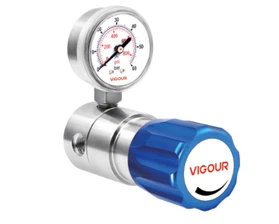
For example, between the two products VSR-1 and VSR-1EL, you can choose the most suitable pressure regulator based on your inlet and outlet pressure requirements.


3️⃣Material
Our pressure regulators come in two materials: Stainless steel and Chrome plated brass:

4️⃣Flow Requirements and Cv Value
Flow capacity (Cv): The regulator's flow coefficient (Cv) defines how much gas or liquid can pass through at a given pressure drop.
Flow curves: Review the manufacturer's flow curves to understand how the outlet pressure behaves at different flow rates. This ensures stable performance under actual operating conditions.
Undersized regulator: May cause excessive pressure drop and insufficient flow.
Oversized regulator: May result in poor control sensitivity.
Each of our products comes with a flow chart:


5️⃣Temperature
Temperature directly affects pressure regulator performance by influencing material strength, seal reliability, and regulation accuracy. High or low temperatures may cause seal failure, leakage, or pressure instability, so it is essential to choose regulators and materials rated for the application's operating temperature range.
Our pressure regulators can typically operate within a temperature range of –30°C to +74°C.
6️⃣Other options
Gauges: Monitor inlet and outlet pressure.
Filters: Protect the regulator and system from particles.
Heater: Prevent condensation in certain gas applications.


7️⃣Conclusion
The selection of pressure regulators needs to consider various factors, in addition to the above, it is also necessary to consider the product's application field, component materials, interface dimensions, etc.
Selecting the right pressure regulator is not just about reducing pressure. A correct choice ensures system stability, process accuracy, safety, and longer equipment life.
If you also have a need for pressure regulators, please contact us.
8️⃣Link