

When selecting regulators and diaphragm valves, the first parameter you need to check is Cv. It defines the maximum flow your gas line can deliver, and tells you whether the selected component is marginally sized, adequately oversized, or simply insufficient. A large share of sizing issues can be traced back to improper Cv selection.
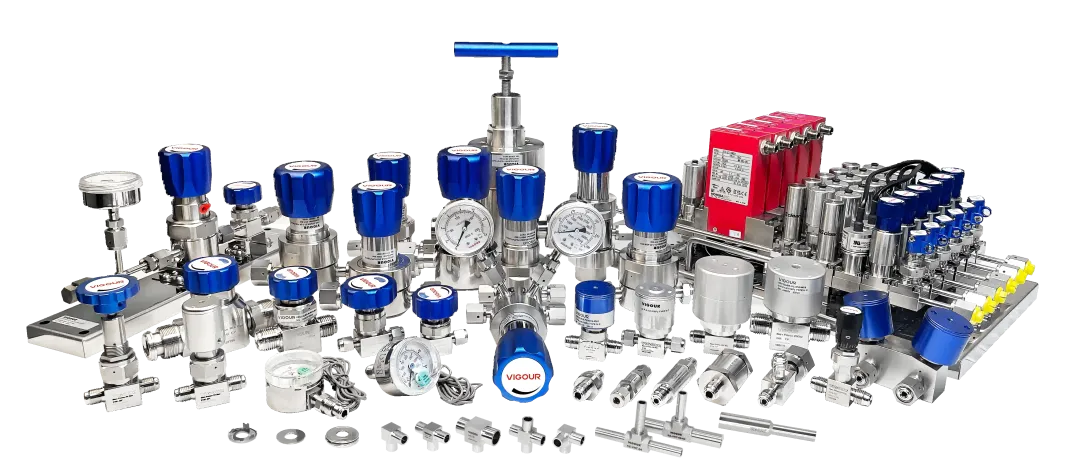
VIGOUR regulators and diaphragm valves feature Cv values ranging from 0.009 to 10, covering low-flow analytical lab gases up to high-flow bulk gas delivery for production lines. Mastering Cv gives you the core logic of gas system component selection.
What is Cv? In short
v is the standardized metric to quantify a valve's flow capacity: a higher Cv means higher achievable flow rate.
Industry definition: Cv equals the US gallons per minute of 60°F water passing through a fully open valve with a 1 psi pressure drop across it. Water is only the universal reference fluid for calibration, unrelated to your process gas. The same valve keeps the identical Cv for air, nitrogen, hydrogen or other gases, as Cv describes the internal flow path geometry, not the working media. All VIGOUR valves are designed for gas service.
The metric equivalent is Kv: Cv ≈ 1.16 × Kv. Two notations, same core meaning.
Important reminder: Cv is the maximum flow capability, not a guaranteed operating flow.
Gas Operating Conditions: One rule worth remembering
Gas is compressible, so there is a critical phenomenon you need to understand. Once the outlet pressure drops below a certain level (roughly less than half of the inlet pressure), the flow rate hits a ceiling. Further reducing the outlet pressure will not increase the flow - this is known in the industry as choked flow.
Analogy: The passage is already fully choked. Opening up the downstream side more will make no difference. For example, with 10 bar inlet pressure and 3 bar outlet pressure, you are already in choked flow.
If you need higher flow under this condition, there are only two solutions: select a valve with a higher Cv value, or raise the inlet pressure.
Note: Gas flow calculations must use absolute pressure, which equals gauge pressure plus atmospheric pressure (1 bar).
What makes VIGOUR products stand out?
Cv is listed clearly on datasheets, yet material grade, surface cleanliness, sealing design and long-term stability are the invisible factors that determine service life and consistent performance of your gas loop. These are the key areas VIGOUR has continuously refined.
VIGOUR Installation Notes
▸ Fine Cv grading to match your operating conditions
Within the same series, flow capacity can vary several times between different port sizes. A common pitfall in valve selection is settling for an ill-fitted model. VIGOUR specifies the Cv value individually for every model and port size. Our product lineup covers Cv from 0.009 up to 10, so you can get the right fit for both ultra-low and high flow applications.
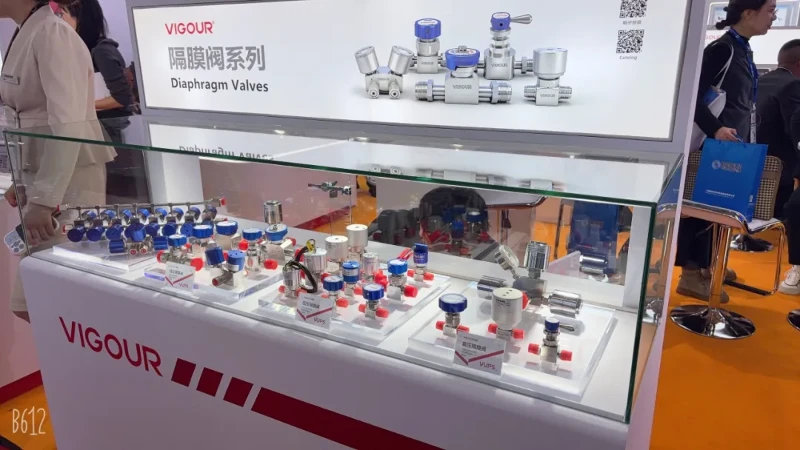
For reference: among our ultra-high purity diaphragm valves, VDV37UB/UC has a Cv of 2.8 for large-bore delivery, while VDV46UB/UC features a Cv of 0.1 for precision regulation.
Stable outlet pressure, immune from inlet pressure drift
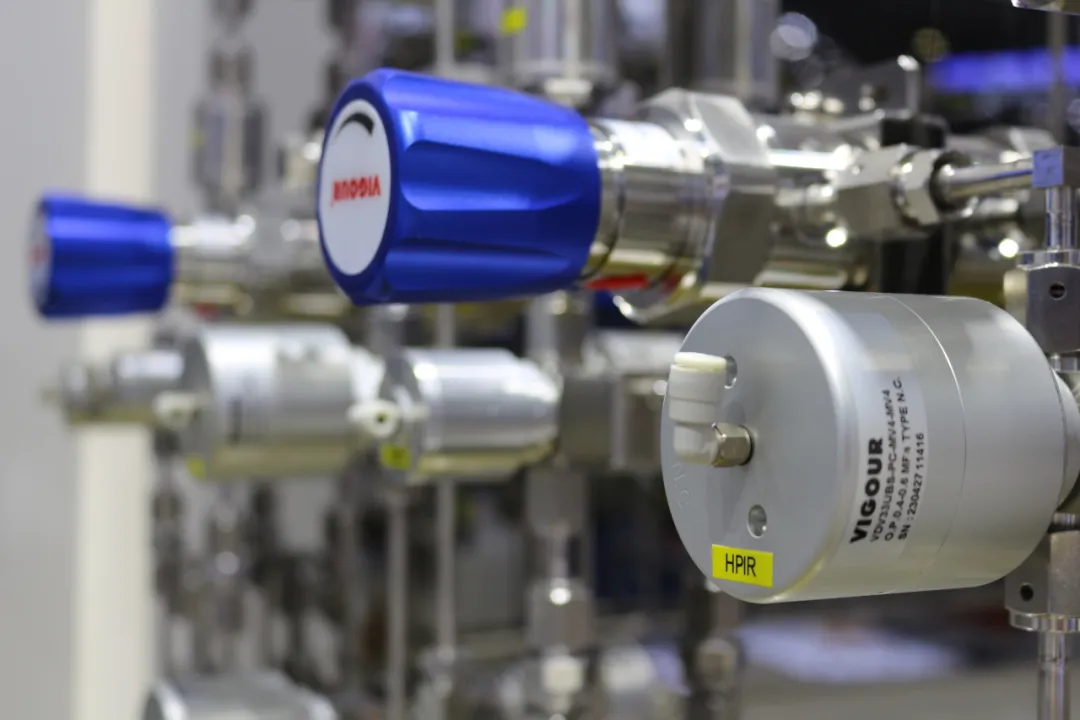
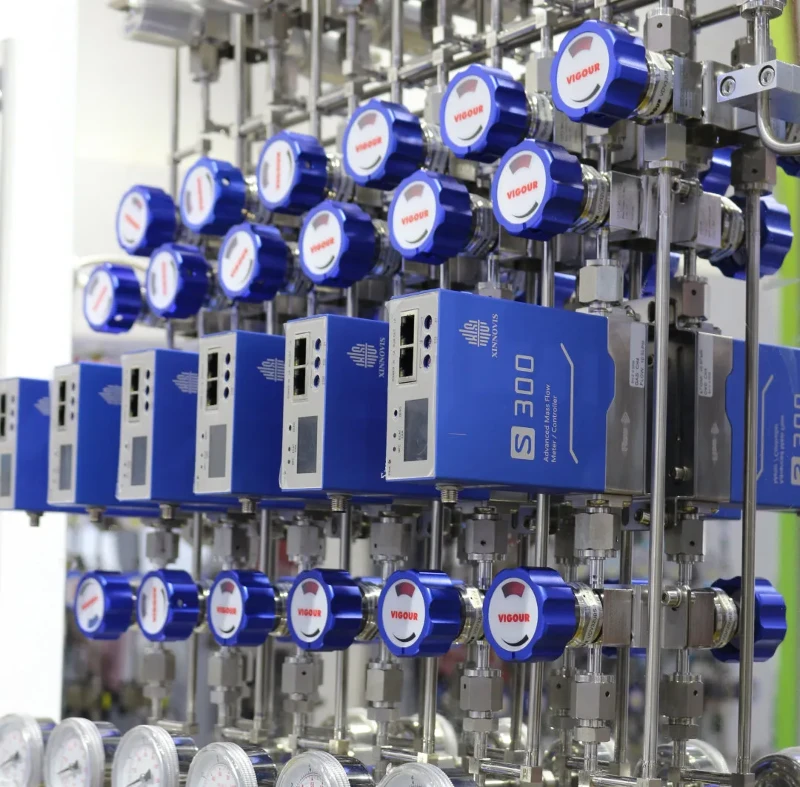
Cylinder inlet pressure drops gradually during consumption. If outlet pressure follows this swing, downstream instruments and process conditions will drift. VIGOUR two-stage and pilot-operated regulators isolate inlet fluctuations effectively. Two-stage design performs coarse regulation first then fine trimming; pilot-operated construction enables high flow together with precise outlet pressure control. For hydrogen applications rated at 350 / 700 bar inlet pressure, outlet pressure stays locked at setpoint. These units are purpose-engineered instead of modified general-purpose regulators.
Cleanliness built-in from manufacturing, not post-process remediation
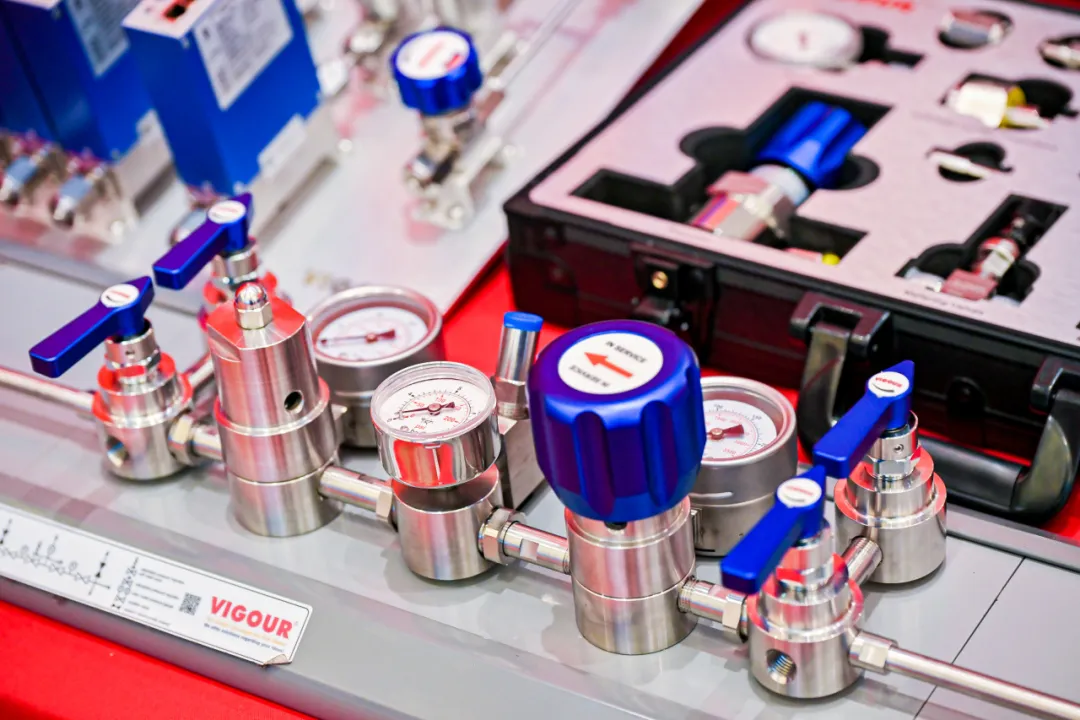
or ultra-high purity gas circuits, the valve itself must not become a contamination source. UB / UC series wetted surfaces are available at 10 μin Ra / 7 μin Ra. Components are cleaned with ultra-pure water and assembled inside cleanroom environments, with critical joints helium leak-checked per specification before shipment. This is why VIGOUR regulators and diaphragm valves are qualified for demanding sectors including semiconductor, photovoltaic and analytical laboratories.
Clean diaphragm seal, no packing gland
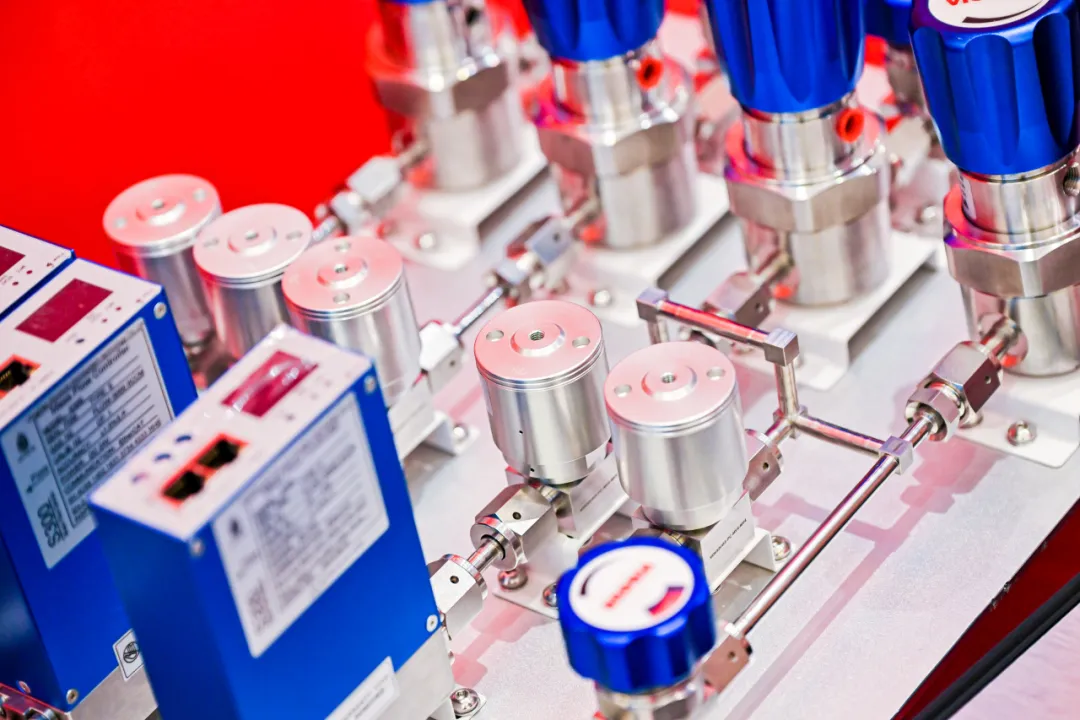
The moving part is the most common failure point for gas valves. VIGOUR diaphragm valves use a metal diaphragm to isolate process gas from the actuator, adopting a packless sealing design. There is no packing material to compress for sealing, eliminating one source of wear and particle generation. Shut-off repeatability and operating feel rely on structural design, not packing aging.
Clean seal design, no packing required
The moving part is where valves most often fail. VIGOUR diaphragm valves use a metal diaphragm to isolate the process media from the actuator. They feature a packing-free external sealing structure. Sealing is achieved without packing compression, eliminating one source of wear and particle generation. Actuation feel and repeatable shutoff rely on the inherent design, rather than the ageing condition of packing.
Verified material and leak integrity
316L stainless steel is standard for valve bodies. For critical UHP service, we offer VIM‑VAR (Vacuum Induction Melting + Vacuum Arc Remelting) double vacuum refined steel. Our ultra-high-purity diaphragm valves achieve helium leak rates down to 10⁻⁹ mbar·L/s He. These specifications are validated by material selection and precision machining, not marketing claims.
Professional sizing support available
Estimating Cv, pressure drop and flow margin manually often leads to inaccuracies. An undersized valve cannot meet demand, while an oversized one is hard to control. Share details including the media, inlet pressure, outlet pressure and allowable pressure drop with us. The VIGOUR technical team will carry out verification calculations to confirm the model for you, saving you the trouble of trial and error.
Three Principles for Cv Selection
Avoid tight sizing
If your calculated required Cv is 0.5, do not pick a valve with Cv = 0.5. We recommend reserving a 20%~30% margin. This compensates for estimation deviations and accommodates potential flow increases in the future.
Nor is higher Cv always better
An over-sized Cv means the valve plug operates at small opening positions most of the time. This degrades repeatability and stability of pressure control, and may trigger oscillation in low-pressure systems. This is especially critical for semiconductor process gas delivery systems.
Refer to Cv by individual port size, avoid generic ranges
Within the same product series, Cv values can vary many times across different port sizes. Always refer to the Cv specified for the exact model and port size, rather than estimating based only on the product series. This is why we emphasize itemised Cv ratings per model.
Unsure about sizing? Get support from VIGOUR engineering team
Contact VIGOUR for one-on-one technical sizing service.
Tel: +86 21-6760 1819 Website: www.vigourco.com


