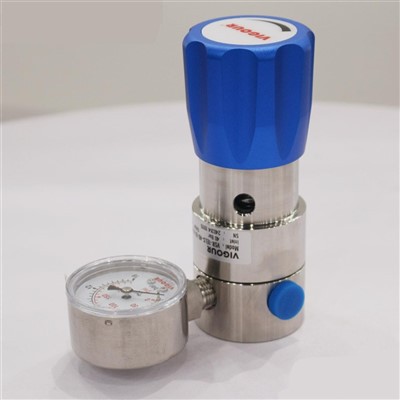
Model
|
VSR-9 |
VSR-120 |
VSR-92 |


Hydrogen Pressure Regulators VSR-9
Introduction
• Piston-sensed design provides a long service life and enhanced safety
• High flow and minimal flow droop
• Balanced valve design minimizes supply pressure effect
• Used in diverse applications for a broad range of temperatures,
flows and pressures
• Wide variety of preset outlet pressure are available
• 10 micron, 316 Stainless Steel filter
Application
- Hydrogen fuel cell vehicles
Technical parameters
| Inlet pressure P1 | max. 350 / 700 bar |
|
| Outlet pressure P2 | 8/10/20/30 bar | |
| Materials Body | 316L / Aluminium | |
| Seat | Vespel® | |
| O-ring | EPDM | |
| Main valve | 316L | |
| Sensor | 316L | |
| Spring | 316L | |
| Filter | 10μm 316 | |
| Leakage | Bubble-tight | |
| Operating temperature | -40℃ to +85℃ | |
| Flow capacity | Cv=0.50 | |
| Weight | 2.4kg |

Reservation information


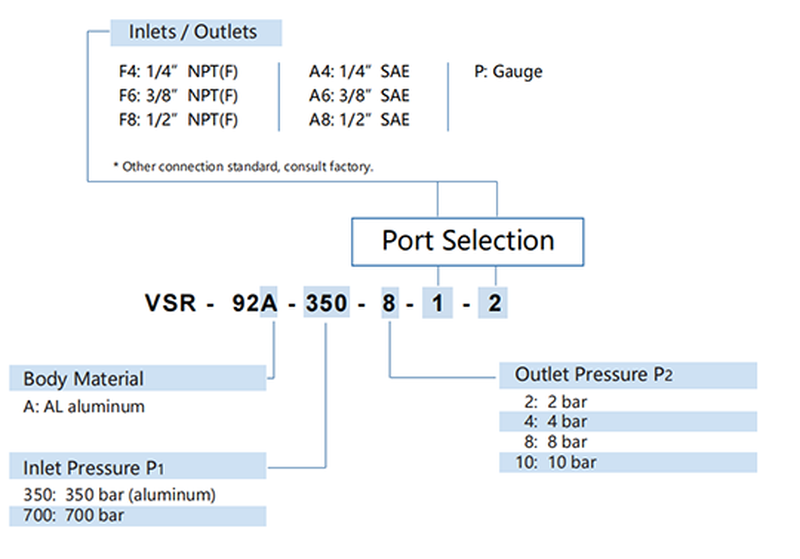
Hydrogen Pressure Regulators VSR-92
Introduction
• High pressure on-board pressure reducer
• Piston type high pressure input, is safe and reliable
• High flow rate meets high power condition of hydrogen new energy
• Multi-specification preset pressure optional
• Porous design, convenient installation of accessories
Application
• Hydrogen vehicle air supply system
Technical parameters
| Type | Dual-stage |
|
| Inlet pressure P1 | max. 350 bar/ 700 bar | |
| Inlet 350 bar: 6~13 bar | ||
| Outlet pressure P2 | Inlet 700 bar: 7~13 bar | |
| Materials Body | Aluminium | |
| Valve seat | vespel® | |
| O-ring | EPDM | |
| Piston | Aluminium | |
| Spring | Piano wire | |
| Filter | 120 μm / 2 μm 316L | |
| Temperature range | -40'℃ to +85°C | |
| Leak rate | Bubble-tight | |
| Weight | 1 .9kg |

Reservation information

Hydrogen Pressure Regulators VSR-120
Introduction
• Low pressure, high flow regulator
• Stainless steel 316L body, Aluminum body
• A variety of hole design, suitable for a variety of inlet and outlet gas structure
• Stable output pressure
• Simple outlet pressure limitation by handwheel
• Tested for use with oxygen
Application
• The hydrogen industry
• Supporting analysis industry
• Food and pharmaceutical industry
Technical parameters
| Type | single-stage |
|
| Inlet pressure P1 | max. 15 bar | |
| Outlet pressure P2 | 1/2/4/7 bar | |
| Materials | ||
| Body regulator | see ordering info | |
| Valve seat: | PCTFE | |
| Diaphragm | Hastelloy® C276 | |
| O-ring: Viton® (FKM) | ||
| (option)Kalrez® (FFKM) | ||
| Filter | SS 316L | |
| Inlets and Outlets | 1/8", 1/4"NPT(F) | |
| Temperature range | -30℃ to +74℃ | |
| Leak rate | (to atmosphere) 1x10^-6 mbar I/s He | |
| (via seat) | Bubble-tight | |
| Weight | 0.4kg (316L) | |
| 0.2kg (Aluminum) | ||

Reservation information


User Guide (In Simple Terms)
What is this thing for?
Simply put, it's the "hydrogen butler" that safely reduces the high pressure from hydrogen cylinders to the working pressure needed. Places like fuel cell power stations and hydrogen production plants rely on it. With hydrogen energy being so hot right now, safely controlling the pressure is top priority.
Why is it so special?
① Materials that can take the pressure
Hydrogen is a sneaky little molecule that loves to slip through gaps, and regular materials can get brittle and leak. So, we use special stainless steel/nickel alloys, and the seals are made of custom PTFE material-just like a bulletproof vest, locking the hydrogen in tightly.
② Pressure range at your service
It can handle pressures from high as 5000 psi (≈340 times atmospheric pressure) down to as low as 15 psi (≈1 atmosphere) for precision operations. Think of it like a car gearbox, with different gears matching different needs.
③ Safety standard kit
- Pressure gauge: Keeps track of the "heartbeat" of the pressure at all times.
- Relief valve: Automatically "vents" if there's too much pressure to keep things safe.
- Check valve: Prevents the gas from backflowing and causing trouble.
④ Flow control that's steady as a scale
Especially in fuel cell applications, the gas flow needs to be as precise as an IV drip-too much is wasted, too little causes a shutdown. Our regulator's precision is within ±1%.
Common Questions - Quick Q&A
Can I use a regular gas regulator?
Absolutely not! A regular regulator is like a sieve-hydrogen molecules will slip through, and it could also make the metal brittle. Last year, XX factory used the wrong regulator, causing a leak and a direct loss of 500,000 (there's news about it).
How can I tell when it's time to replace the regulator?
Keep an eye out for three signs: the needle shakes like it's got Parkinson's, frost at the connection, or a rotten egg smell (we add a warning agent). If you notice these, immediately call our 24-hour technical hotline.
Is regular maintenance hard?
Just follow the "three do's and three don'ts":
- Do leak checks monthly (using test strips)
- Do clean the connections regularly
- Do record pressure fluctuations
- Don't force the valve
- Don't disassemble parts yourself
- Don't expose to direct sunlight
What parameters should I focus on when selecting a regulator?
Keep an eye on these three numbers:
- Inlet pressure (check the cylinder label)
- Working pressure (ask the equipment supplier)
- Flow requirement (check the equipment manual)
Still unsure? Just snap a photo of the equipment nameplate and send it to me via WeChat. Our engineers will help you select the right model for free.
Emergency Handling
What to do if you discover a leak? Remember the "Stop, Evacuate, Report" rule:
Immediately close the cylinder's main valve
Everyone evacuates to upwind
When calling our emergency number, loudly report the equipment code (stamped on the side of the regulator)
We have 50 service locations across the country that will respond within 2 hours, and last year we handled 37 leak incidents with zero casualties.
Hot Tags: hydrogen pressure regulators, China hydrogen pressure regulators manufacturers, suppliers, Line Pressure Regulator in stock sample available, 700bar Pressure Gas Regulator stainless steel single stage, gas regulator for plating, High Pressure High Flow Regulator dual stage nitrogen, gas regulator replacement, gas regulator for science