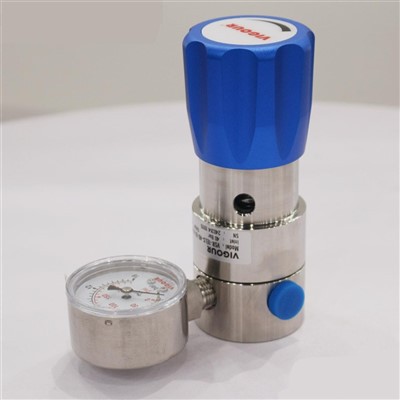
Hey there! As a supplier of Back Gas Pressure Regulators, I've been getting a lot of questions lately about the role of the pressure gauge in these regulators. So, I thought I'd take a few minutes to break it down for you.
First things first, let's talk about what a Back Gas Pressure Regulator is. In simple terms, it's a device that controls the pressure of gas flowing through a system. It ensures that the gas is delivered at a consistent and safe pressure, which is crucial for the proper functioning of many industrial and commercial applications.
Now, let's get to the main topic - the pressure gauge. The pressure gauge is an essential component of a Back Gas Pressure Regulator. It provides real - time information about the pressure of the gas in the system. This information is vital for several reasons.
One of the primary roles of the pressure gauge is safety. In any gas system, maintaining the correct pressure is crucial. If the pressure is too high, it can lead to leaks, explosions, or damage to the equipment. On the other hand, if the pressure is too low, the system may not function properly. The pressure gauge allows operators to monitor the pressure constantly and take action if it goes out of the safe range. For example, if the gauge shows that the pressure is rising above the set limit, the operator can adjust the regulator to bring the pressure back down.
Another important role is efficiency. Different applications require different gas pressures to operate efficiently. For instance, in a manufacturing process, a specific pressure may be needed to ensure the quality of the products. The pressure gauge helps operators set the correct pressure for the application. By monitoring the pressure, they can make adjustments to optimize the performance of the system, reducing waste and saving energy.
Let's say you're using a Back Gas Pressure Regulator in a food processing plant. The Food Industrial Use Gas Pressure Regulator needs to maintain a precise pressure to ensure the safety and quality of the food products. The pressure gauge allows you to keep an eye on the pressure and make sure it stays within the required range.
The pressure gauge also plays a role in troubleshooting. If there are issues with the gas system, such as inconsistent gas flow or equipment malfunctions, the pressure gauge can provide valuable clues. A sudden drop or increase in pressure may indicate a leak, a blockage, or a problem with the regulator itself. By analyzing the pressure readings, technicians can quickly identify and fix the problem.
In addition to these functions, the pressure gauge is also useful for maintenance purposes. Regularly checking the pressure reading can help detect early signs of wear and tear in the regulator or other components of the gas system. If the pressure starts to fluctuate or shows an abnormal reading, it may be a sign that the regulator needs to be serviced or replaced.
Now, let's talk about the different types of pressure gauges used in Back Gas Pressure Regulators. There are mechanical gauges and digital gauges. Mechanical gauges are the traditional type and use a spring - loaded mechanism to measure pressure. They are simple, reliable, and relatively inexpensive. Digital gauges, on the other hand, use electronic sensors to measure pressure. They offer more accurate readings and can often be connected to a monitoring system for remote observation.
When it comes to choosing a pressure gauge for your Back Gas Pressure Regulator, several factors need to be considered. The accuracy of the gauge is crucial. You want a gauge that can provide precise readings within the required pressure range. The durability of the gauge is also important, especially if it's going to be used in a harsh industrial environment.
The size and readability of the gauge are other factors. You want a gauge that is easy to read, even from a distance. And of course, the cost is always a consideration. You don't want to overspend on a gauge, but at the same time, you don't want to compromise on quality.


As a supplier of Back Gas Pressure Regulators, we offer a wide range of pressure gauges to suit different needs and budgets. Whether you need a basic mechanical gauge for a small - scale application or a high - tech digital gauge for a large industrial system, we've got you covered.
We also supply other types of pressure regulators, like the Line Pressure Regulator. This type of regulator is used to control the pressure in a pipeline, ensuring a steady flow of gas. And our Single Stage Gas Pressure Regulator is a popular choice for many applications, offering simple and reliable pressure control.
If you're in the market for a Back Gas Pressure Regulator or any related components, we'd love to hear from you. Our team of experts can help you choose the right products for your specific needs. We offer high - quality products at competitive prices, and we're committed to providing excellent customer service.
So, if you have any questions or if you're ready to start a procurement discussion, don't hesitate to reach out. Whether you're a small business owner or a large industrial operator, we have the solutions to meet your gas pressure regulation needs.
References
- Gas Pressure Regulation Handbook
- Industrial Gas Systems Manual