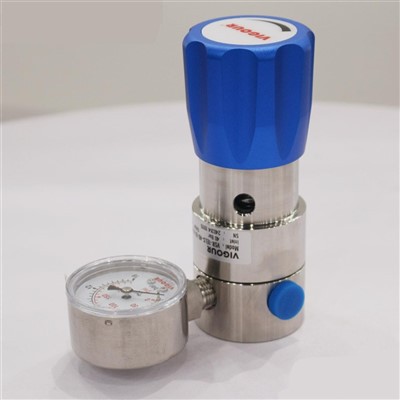
As a leading supplier of high purity gas filters, I often get asked about the maximum particle size that our filters can remove. This is a crucial question, especially for industries that rely on ultra - clean gas supplies, such as semiconductor manufacturing, pharmaceuticals, and high - end research laboratories.
Understanding the Basics of High Purity Gas Filters
Before delving into the maximum particle size removal capabilities, it's essential to understand how high purity gas filters work. These filters are designed to remove contaminants from gas streams, ensuring that the gas delivered is of the highest purity. The filtration process typically involves a combination of physical and chemical mechanisms.
Physical filtration relies on the size of the pores in the filter media. Gas molecules and particles smaller than the pore size can pass through, while larger particles are trapped. Chemical filtration, on the other hand, involves the use of adsorbents or catalysts to remove specific contaminants, such as reactive gases or volatile organic compounds.
Factors Affecting the Maximum Particle Size Removal
Several factors influence the maximum particle size that a high purity gas filter can remove. These include the type of filter media, the filter design, and the operating conditions.
Filter Media
The choice of filter media is one of the most critical factors. Different materials have different pore sizes and surface properties, which directly affect the filtration efficiency. Common filter media for high purity gas filters include sintered metals, ceramics, and polymers.
Sintered metal filters are known for their high strength and durability. They can be engineered to have a wide range of pore sizes, typically from a few micrometers down to sub - micrometer levels. These filters are excellent for removing larger particles and are often used as pre - filters to protect downstream, more sensitive filters.
Ceramic filters offer high chemical resistance and can operate at high temperatures. They have a very uniform pore structure, which allows for precise control of the particle size removal. Ceramic filters can achieve high filtration efficiencies for particles in the sub - micrometer range.
Polymer filters, such as PTFE (polytetrafluoroethylene), are popular due to their low surface energy and chemical inertness. They are often used in applications where the gas must be kept free from any trace of contamination. Polymer filters can effectively remove particles as small as 0.01 micrometers.
Filter Design
The design of the filter also plays a significant role in determining the maximum particle size removal. Filters can be designed as pleated, cylindrical, or flat sheet configurations. Pleated filters have a larger surface area, which allows for more efficient particle capture and longer service life. Cylindrical filters are often used in applications where high flow rates are required, while flat sheet filters are suitable for low - flow, high - precision applications.
Operating Conditions
The operating conditions, such as gas flow rate, pressure, and temperature, can also affect the filter's performance. Higher gas flow rates can reduce the filtration efficiency, as particles may have less time to be captured by the filter media. High pressures can cause the filter media to compress, reducing the pore size and potentially increasing the filtration efficiency but also increasing the pressure drop across the filter. Temperature can also affect the properties of the filter media, such as its porosity and chemical stability.
Typical Maximum Particle Size Removal Capabilities
In general, high purity gas filters can remove particles ranging from a few micrometers down to the nanometer scale. For coarse pre - filters, the maximum particle size removal can be as large as 100 micrometers. These filters are used to remove large debris and protect downstream filters from premature clogging.
Intermediate filters can typically remove particles in the range of 1 - 10 micrometers. These filters are used to further reduce the particle load and protect the final, high - efficiency filters.
Final high - efficiency filters, such as those used in semiconductor manufacturing or cleanroom applications, can remove particles as small as 0.01 micrometers or even smaller. These filters are designed to provide ultra - clean gas supplies, meeting the strictest purity requirements.
Complementary Products for High Purity Gas Systems
In addition to high purity gas filters, we also offer a range of complementary products to ensure the safe and efficient operation of high purity gas systems. These include [Gas Pressure Transmitter](/hp - accessories/gas - pressure - transmitter.html), [Gas Flashback Arrestors](/hp - accessories/gas - flashback - arrestors.html), and [Gas High Pressure Hoses](/hp - accessories/gas - high - pressure - hoses.html).
Gas pressure transmitters are essential for monitoring and controlling the pressure in gas systems. They provide accurate and reliable pressure measurements, ensuring that the system operates within the specified pressure range.
Gas flashback arrestors are designed to prevent the reverse flow of flame in gas systems, protecting the equipment and personnel from potential hazards. They are commonly used in applications where flammable gases are involved.


Gas high pressure hoses are used to transport high - pressure gases safely. They are made from high - quality materials and are designed to withstand high pressures and harsh operating conditions.
Contact Us for Your High Purity Gas Filtration Needs
If you are in need of high purity gas filters or any of our complementary products, we invite you to contact us for a detailed discussion of your requirements. Our team of experts is ready to provide you with the best solutions tailored to your specific applications. Whether you are in the semiconductor industry, pharmaceuticals, or any other field that requires ultra - clean gas supplies, we have the products and expertise to meet your needs.
References
- "Filtration Handbook", Fourth Edition, by Peter A. Schweitzer.
- "Gas Filtration Technology" by various authors, published by the Institute of Gas Engineers and Managers.
- Technical literature from leading high purity gas filter manufacturers.